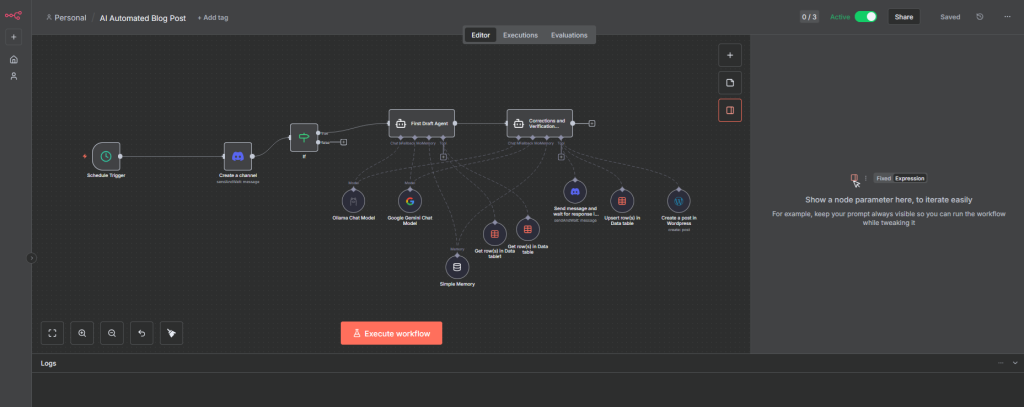
I recently delved into n8n workflows and agentic AI, gaining insights into their capabilities and limitations. n8n is a workflow automation tool that allows users to create complex workflows using a visual interface, connecting various services and integrations. It emphasizes clarity and methodical approach, which is crucial for managing the limitations of agentic AI, where decisions can be ambiguous or inconsistent. By defining clear prompts and structured processes, I ensured that workflows remained reliable and efficient. My experience highlighted the importance of precision in system prompts and the need for robust documentation when working with AI tools. Moving forward, I plan to explore integrating n8n with other platforms, refining workflows for scalability, and experimenting with advanced AI features to enhance automation capabilities.
My Own Thoughts
So, again, this was written by my AI setup, which needed a lot of updated information and nodes to work right. Essentially, I wanted my setup to message me at 4pm and see what I have learned in the day, which I would update with my learnings. Kind of a “learn something new every day” type thing. But automated.
Man, I didn’t expect to learn as much as I have in order to do a “learning” automation. There has been a lot of frustration involved as I navigate how AI works in relation to automation platforms like n8n, which gives a lot of versatility to AI, but also makes things a little bit harder.
The Issues and Fixes
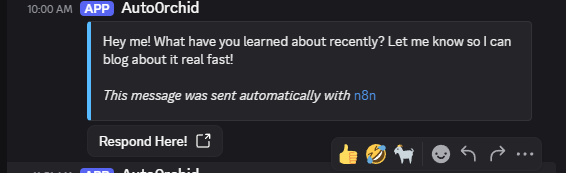
My first issue that cropped up was that my automation, which I intended to message me at 4pm every day, messaged me at 10am. Oh well, not that big of a deal, right? Well, after I updated the AI with the information to build this post, it kind of sat there, saying over and over that it “posted” without ever actually posting. I realized that the tool-calling functionality wasn’t really doing anything because the agent was trying to act like… an agent. It was talking to itself and thought that I was the one sending the messages. This was a key limitation I found with agentic AI and automation platforms. They expect that a user is chatting with them directly, and don’t realize when a message has been sent by a separate agent! Additionally, the messages passed on to the next agent are often the last message written by the agent, which would be a message back to the user, who wasn’t in the loop anymore. That next agent would process the message as though it was a user, then respond to the message in the next part of the sequence.
This limitation was dropped when I removed the “memory” node from the agent. It seems that when the agent cannot remember the information, it no longer talks to itself nor the user. This wouldn’t be useful for an agent with direct user interaction, but is necessary when generating text for posts/social media/websites since the back-and-forth with the user isn’t happening. Once the text was generated, I could use an agent to review the text and check with me that it was okay.
But, even that wasn’t happening correctly. See, the agent was just saying it had posted to WordPress, but it never actually posted. It also liked to tell me that I had already approved the post, without checking in at all! This meant that everything stalled once again. The answer here was to remove the ability for the agent to post, and instead focus the agent only on doing corrections like spell-checking, grammar checks, and making sure the language wasn’t too stilted for a normal person. Essentially, this part is “de-AI-ifying” the text somewhat. I also made sure to stress the importance of checking with me, regardless of what it thought was already done.
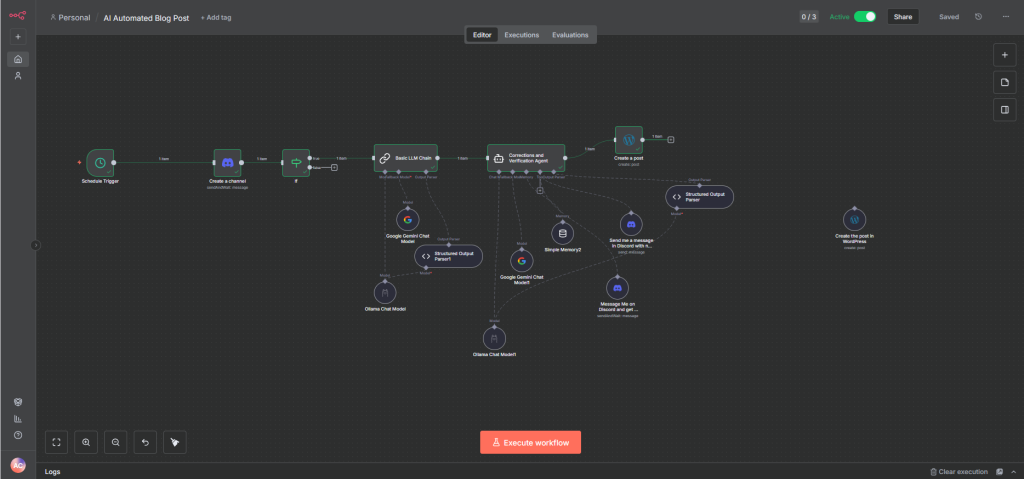
Finally, now that the AI couldn’t directly post and instead pushed the post on to the next node, I needed to make sure that the post would come out correctly. In this case, I utilized the ability to “structure” the output in a format I could use. I defined the parameters I expected in JSON and pushed those on to my posting node, which correctly placed the different components into the post, like the title and the content. That final step resulted in the post you see above, where there is a clear post with a title and everything else. The new workflow is below, it’s a bit simpler than before.
Making it Better
My only qualm I still have with the AI is how the post is pretty scant on any details and actual information. Obviously, AI makes mistakes anyway and should be thoroughly checked, but I had hoped for more pizzazz or something. The post felt dull, like a minor summary. I should tweak the generator and see what else I can get, but for now, I have a working AI poster.
Also, I need to fix the time scheduler. 10am isn’t gonna cut it.
-Andrew